
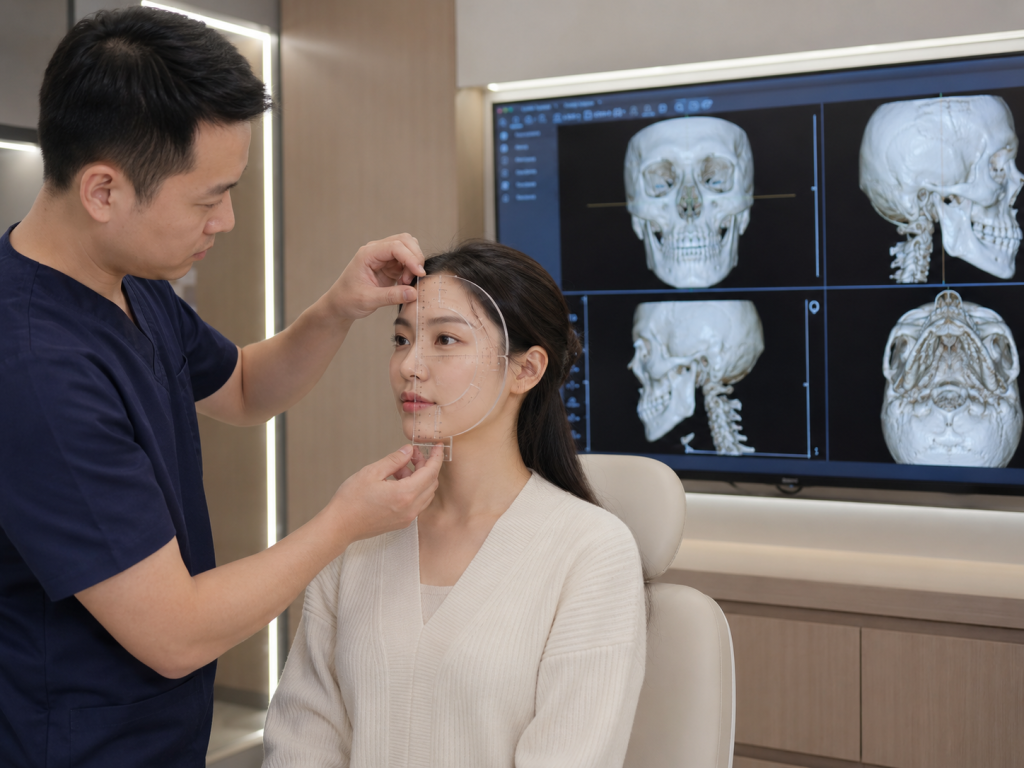
Jaw surgery should correct the bite — but it should also respect the face and protect the airway
Orthognathic surgery is often described as surgery to correct the bite. That is true, but it is not enough.
The jaws do not exist only to hold the teeth. They form the structural foundation of the face and help define the space available for the tongue, throat and upper airway. Moving the upper or lower jaw can affect not only how the teeth meet, but also the facial profile, smile, lip support, chin position, nasal base, jawline and airway.
For this reason, our approach to orthognathic surgery is not purely occlusion-centric. It is face and airway-centric.
This means that treatment planning begins not only with the question:
“How do we make the teeth fit?”
but also with:
“How do we position the jaws to support facial balance, smile aesthetics, airway space and long-term function?”
A good bite is essential. But in modern orthognathic surgery, the bite should be planned within the wider context of the face and airway.
The limitation of a purely occlusion-centric approach
A traditional occlusion-centric approach focuses mainly on how the upper and lower teeth fit together.
This remains important. A stable bite is one of the key goals of orthognathic surgery. The orthodontic-surgical plan must allow the jaws and teeth to meet in a functional, stable and maintainable position.
However, if planning focuses mainly on dental occlusion, important facial and airway considerations may be under-emphasised.
A technically good bite does not automatically mean the best overall outcome.
For example, a plan that corrects the bite may still leave the patient with:
- a flat or unsupported midface;
- poor upper lip support;
- strained lip closure;
- excessive or deficient chin projection;
- an unbalanced facial profile;
- excessive lower facial height;
- residual facial asymmetry;
- an unaesthetic smile arc or excessive gum display;
- a narrow or compromised airway;
- worsening of tongue space or throat space;
- an outcome that is dentally corrected but facially or functionally incomplete.
Orthognathic surgery should not be planned as dental engineering alone. It is facial skeletal and functional reconstruction.
What is face and airway-centric orthognathic planning?
Face and airway-centric planning considers the bite as part of a larger skeletal, soft tissue and functional system.
The aim is to balance:
- dental occlusion;
- facial proportions;
- smile aesthetics;
- lip posture and lip competence;
- midface support;
- chin position;
- jawline definition;
- nasal base and upper lip relationship;
- facial symmetry;
- soft tissue response;
- tongue space;
- airway dimensions;
- breathing and sleep-related considerations where relevant;
- temporomandibular joint health;
- long-term skeletal and dental stability.
In this approach, occlusion remains essential, but it is not the only driver of the surgical plan.
Instead of simply asking where the teeth should meet, we ask where the jaws should be positioned to best support the patient’s face, airway and function.
Why facial aesthetics matter in jaw surgery?
The jaws form the foundation of the face.
The upper jaw influences the midface, cheek support, nasal base, upper lip, smile display and dental show. The lower jaw influences the chin, jawline, lower lip, neck-throat angle and facial profile. The relationship between the upper and lower jaws affects overall facial harmony.
Small differences in jaw movement can produce meaningful differences in appearance.
For example:
- advancing the upper jaw can improve midface support and upper lip projection;
- repositioning the upper jaw can improve vertical facial proportions and gum display;
- advancing the lower jaw can improve chin projection, jawline and facial balance;
- rotating the upper and lower jaws together can influence facial height, chin position, occlusal plane and airway;
- correcting asymmetry requires assessment of the whole face, not just the dental midline;
- genioplasty may be considered when chin position needs to be refined independently of the bite.
A face-centric approach helps ensure that the plan is not limited to making the dental models fit together, but also considers how the patient will look, smile and function after surgery.
The aim is not to create an artificial or standardised face. The aim is to support a natural, balanced result that respects the patient’s own facial identity.
Why airway planning matters
The position of the jaws can affect the space behind the tongue and soft palate.
In some patients, a small or retrusive lower jaw, narrow jaw structure, steep occlusal plane or deficient upper jaw may contribute to reduced airway space. In selected patients, jaw advancement can improve the skeletal framework around the upper airway and may be part of treatment planning for obstructive sleep apnoea or sleep-disordered breathing.
Airway considerations are especially important in patients with:
- retrusive upper and lower jaws;
- small lower jaw or weak chin projection;
- obstructive sleep apnoea;
- snoring or sleep-disordered breathing;
- narrow posterior airway space;
- high mandibular plane angle or long face pattern;
- previous orthodontic camouflage;
- planned mandibular setback;
- complex jaw deformity affecting tongue space.
A purely bite-driven plan may not fully consider how jaw movement affects breathing space. For example, mandibular setback can correct an underbite, but in some patients it may reduce tongue and airway space. In contrast, maxillomandibular advancement may improve both facial projection and airway dimensions in selected cases.
Airway-centric planning does not mean every patient needs airway surgery. It means that airway impact should be assessed and respected when planning jaw movement.
Bite, face and airway should be planned together
The ideal orthognathic plan is not purely dental, purely cosmetic or purely airway-driven.
It integrates all three:
Occlusion:
Can the teeth meet in a stable, functional and maintainable bite?
Face:
Do the jaw movements improve or preserve facial balance, smile aesthetics, lip support and symmetry?
Airway:
Do the jaw movements preserve or improve airway space, tongue space and breathing-related function where relevant?
In some patients, all three goals align naturally. In others, there may be trade-offs. The role of careful planning is to recognise these trade-offs before treatment begins.
This is why the surgical plan should not be determined only at the end of orthodontic treatment. The desired facial and airway goals should be discussed early, so that orthodontic tooth movement supports the intended skeletal movement.
The bite is important — but the face and airway give the context
A stable bite remains essential. Orthodontic preparation and surgical occlusion are central to successful orthognathic treatment.
However, the planned bite should serve the overall skeletal plan.
In some patients, orthodontic camouflage may have moved the teeth into positions that hide the underlying jaw discrepancy. Before surgery, the teeth may need to be decompensated so the jaws can be moved into a better facial and airway position.
This is why coordination between surgeon and orthodontist is so important.
A face and airway-centric approach does not ignore occlusion. It places occlusion within a broader plan.
The goal is:
a stable bite, balanced face, supported airway and long-term function.
Common conditions where face and airway-centric planning is important
This approach may be especially important for patients with:
- underbite or Class III jaw relationship;
- overbite or small lower jaw;
- facial asymmetry;
- long face pattern;
- short face pattern;
- gummy smile;
- open bite;
- deep bite;
- retrusive chin;
- excessive chin prominence;
- midface deficiency;
- weak jawline;
- obstructive sleep apnoea;
- snoring or suspected airway restriction;
- previous orthodontic camouflage;
- relapse after previous orthodontic or surgical treatment;
- congenital or developmental jaw differences;
- facial imbalance that cannot be corrected by orthodontics alone.
In these patients, simply aligning the teeth may not fully address the skeletal, facial or airway problem.
Smile, lips and facial expression
Orthognathic surgery can affect the smile.
The amount of tooth display, gum display, upper lip support, smile arc and facial animation should be considered during planning. A patient may have a technically corrected bite but still feel dissatisfied if the smile does not look natural or balanced.
A face-centric assessment considers:
- how much upper incisor is shown at rest;
- how much gum is shown during smiling;
- whether the upper lip is supported;
- whether the lips close comfortably;
- whether the chin muscles strain during lip closure;
- whether the smile is canted or asymmetric;
- whether jaw movement may improve or worsen these features.
These considerations are not superficial. They are part of how jaw position affects everyday expression, confidence and comfort.
Airway, tongue space and sleep-related function
Airway planning looks beyond the teeth.
It considers how jaw position affects the space available for the tongue and the airway behind it. In selected patients, especially those with retrusive jaws or obstructive sleep apnoea, advancing the jaws may improve the skeletal support of the airway.
Assessment may include:
- clinical history of snoring or sleep-disordered breathing;
- facial and jaw relationship;
- CBCT evaluation of airway anatomy where appropriate;
- tongue space and jaw projection;
- occlusal plane orientation;
- whether planned jaw movements may narrow or enlarge airway space;
- coordination with sleep physicians or ENT specialists where needed.
The aim is not to promise that jaw surgery will cure every airway problem. The aim is to ensure airway is not ignored when planning major jaw movement.
The role of digital planning
Modern orthognathic surgery planning may involve clinical examination, photographs, dental scans, radiographs, CBCT imaging and virtual surgical planning.
Digital tools can help visualise:
- jaw position;
- skeletal asymmetry;
- occlusal plane;
- dental relationship;
- facial proportions;
- soft tissue response;
- airway space;
- surgical movements;
- splint design;
- patient-specific planning.
However, technology is only useful when guided by a clear clinical philosophy.
Digital planning should not simply move the jaws until the teeth fit. It should be used to evaluate how different movements affect the bite, face and airway together.
Our face and airway-centric planning process
Our planning approach includes several stages.
1. Facial assessment
We assess facial proportions, symmetry, profile, smile, lip posture, chin position, vertical height, midface support and soft tissue balance.
2. Airway and functional assessment
Where relevant, we assess airway space, tongue space, breathing-related concerns, sleep history, jaw projection and the likely airway impact of proposed jaw movements.
3. Dental and occlusal assessment
The bite, dental alignment, midlines, arch coordination, incisor inclination and orthodontic preparation are reviewed.
4. Skeletal assessment
The upper jaw, lower jaw, chin, occlusal plane, facial asymmetry and jaw relationship are evaluated.
5. Orthodontic-surgical coordination
The orthodontic plan and surgical plan are coordinated so that tooth movement supports the intended skeletal, facial and airway goals.
6. Digital planning where appropriate
CBCT, digital dental models and virtual surgical planning may be used to help plan jaw movement and surgical splints.
7. Discussion of options
Patients are guided through the expected benefits, limitations, risks and realistic changes that may result from surgery.
Why this philosophy matters to patients
Patients do not experience orthognathic surgery as a bite correction alone.
They experience it when they look in the mirror, smile in photographs, chew food, close their lips, speak, breathe, sleep and interact with others.
A face and airway-centric philosophy recognises that jaw surgery affects the whole person.
The aim is not to chase a perfect ideal face or to over-medicalise every airway concern. The aim is to make a careful, individualised plan that improves function while respecting facial aesthetics, airway health and long-term stability.
A balanced approach
A purely cosmetic approach would be incomplete. A purely occlusal approach would also be incomplete. A purely airway-driven approach may also overlook important dental and facial considerations.
Orthognathic surgery sits at the intersection of function, aesthetics and airway.
At our clinic, we believe that a successful orthognathic result should aim for:
- a stable and functional bite;
- balanced facial proportions;
- natural smile aesthetics;
- comfortable lip posture;
- appropriate chin and jaw position;
- improved symmetry where possible;
- airway awareness and optimisation where relevant;
- long-term skeletal and dental stability.
It means that the surgical plan considers not only how the teeth meet, but also how jaw movement affects facial aesthetics, smile, lip support, chin position, airway space and long-term function.
Orthognathic surgery is commonly performed to correct jaw and bite discrepancies. However, because the jaws support the face and influence airway space, surgery can also affect facial balance, smile, lip posture and breathing-related anatomy. These factors should be considered during planning.
No. Facial planning does not mean the surgery is purely cosmetic. It means that facial balance is considered together with bite, stability, airway and health.
In selected patients, especially those with retrusive jaws or obstructive sleep apnoea, jaw advancement may improve airway dimensions. However, suitability depends on the individual patient and should be assessed carefully.
Certain jaw movements, such as mandibular setback, may reduce tongue space or airway dimensions in some patients. This is why airway impact should be considered during planning.
Braces can align teeth, but they cannot fully correct significant skeletal jaw discrepancies. In some patients, orthodontics alone may camouflage the problem. Orthognathic surgery may be considered when the jaw relationship itself needs correction.
Jaw surgery can change facial appearance because the jaws support the facial soft tissues. The amount and type of change depend on the surgical movements, soft tissue response and the patient’s original facial structure.
Orthodontic preparation positions the teeth so that the jaws can be moved correctly. Good coordination between surgeon and orthodontist is essential for bite, facial and airway outcomes.
Digital planning can be very useful, especially in complex jaw deformity, asymmetry, airway-sensitive planning and multi-jaw surgery. However, it is a tool, not a substitute for clinical judgment.
This is exactly why face and airway-centric planning is important. Patients should discuss facial aesthetics, smile concerns, breathing issues or sleep-related symptoms early, before orthodontic preparation and surgical planning are finalised.
Arrange a consultation
If you are considering orthognathic surgery, jaw correction, underbite surgery, facial asymmetry correction, airway-related jaw surgery or treatment for a jaw-related bite problem, a face and airway-centric assessment can help clarify the relationship between your bite, jaws, face, smile and airway.
A consultation allows us to assess not only how the teeth meet, but how the jaws support the face and airway as a whole.