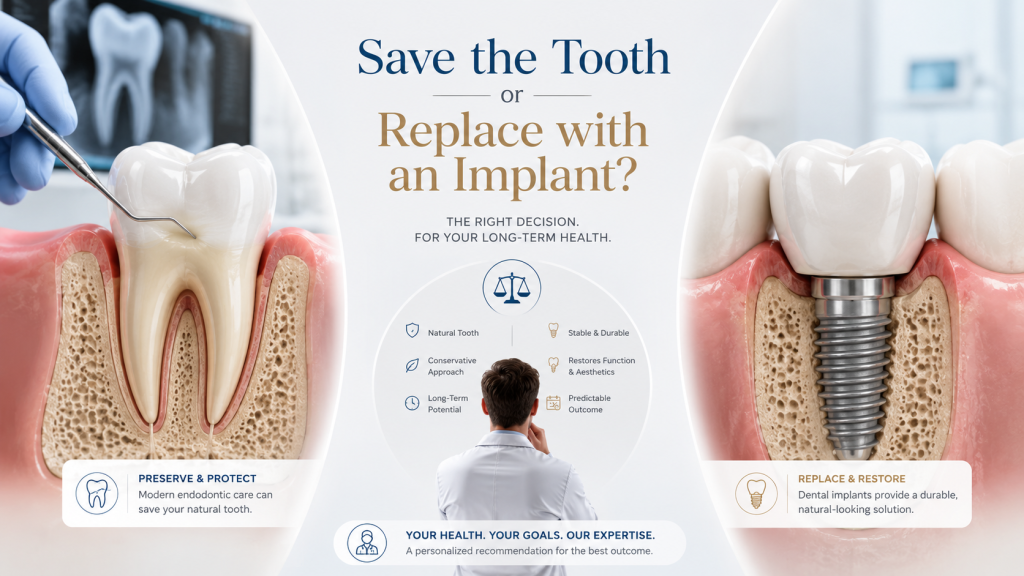
When a tooth is badly damaged, infected, cracked or has had a previous root canal treatment, the right decision is not always obvious. Some teeth can be predictably preserved with root canal treatment, retreatment or surgical endodontics. Others may have a poor long-term prognosis and may be better replaced with an implant or another prosthetic option.
Our assessment helps patients understand whether tooth preservation or implant replacement is likely to provide the more predictable long-term outcome.
Who is this assessment for?
This assessment may be useful if:
- You have been told that a tooth needs to be extracted.
- You are considering a dental implant.
- A previous root canal treatment has failed.
- You have infection around the root of a tooth.
- You have a cracked or heavily restored tooth.
- You are unsure whether root canal retreatment is worthwhile.
- You want a second opinion before losing a tooth.
- You have been advised that bone grafting may be needed before an implant.
We assess the tooth before recommending replacement
At our clinic, teeth considered for extraction and implant replacement are first assessed from both tooth-preservation and implant-reconstruction perspectives. This allows patients to understand the benefits, limitations and long-term prognosis of each option before making a decision.
We do not start with the question, “Can we place an implant?” We start with the question, “What is the best long-term solution for this tooth and this patient?”
What we assess
During the assessment, we consider:
- whether the tooth is structurally restorable;
- whether the root canal system can be predictably treated or retreated;
- whether surgical endodontics may be appropriate;
- whether there is a crack, perforation, resorption or root fracture;
- whether there is adequate periodontal and bone support;
- whether the bite or chewing forces affect prognosis;
- whether extraction and implant replacement may be more predictable;
- whether bone grafting is required;
- whether medical conditions affect treatment choice;
- whether the implant site is anatomically complex.
| Option | May be suitable when | May be less suitable when |
|---|---|---|
| Root canal treatment or retreatment | The tooth is restorable and the root structure is favourable | The tooth has a poor structural or periodontal prognosis |
| Surgical endodontics | Infection persists despite previous root canal treatment and the tooth is otherwise worth preserving | The root or surrounding bone condition makes surgery unpredictable |
| Extraction and implant replacement | The tooth cannot be predictably saved or has a poor long-term prognosis | There is inadequate bone, complex anatomy or unresolved infection requiring staged planning |
Why both tooth-preservation and implant perspectives matter
The decision to save or replace a tooth is not only an endodontic decision and not only an implant decision. It involves the condition of the root, restorability, infection, bone support, bite forces, surgical anatomy, medical history and long-term prognosis.
By assessing the case from both perspectives, patients can make a more informed decision before proceeding with root canal retreatment, surgical endodontics, extraction, bone grafting or implant replacement.
How the assessment works
- Consultation and history
We review symptoms, previous treatment, dental history and patient concerns. - Clinical examination
The tooth, surrounding gum, bite and restorability are assessed. - Radiographic assessment
Existing X-rays are reviewed. CBCT imaging may be recommended where the anatomy, infection or implant site requires further assessment. - Tooth-preservation assessment
We consider whether root canal treatment, retreatment or surgical endodontics is appropriate. - Implant-replacement assessment
If the tooth has a poor prognosis, we assess extraction, bone grafting and implant replacement options. - Discussion of options
Patients receive an explanation of the likely benefits, limitations, risks and prognosis of each option. - Treatment planning
A staged plan may be recommended where infection, bone loss or medical factors require careful sequencing.
Frequently asked questions
No. Some teeth can be predictably preserved. Others may have a poor long-term prognosis and may be better replaced. The decision depends on the condition of the tooth, root, surrounding bone, bite and patient factors.
A second opinion can be helpful when the tooth is important, the decision is complex, or the patient is unsure whether the tooth can be saved.
Failed root canal treatment does not always mean the tooth must be removed. Depending on the cause, options may include retreatment, surgical endodontics, extraction or implant replacement.
Some cracked teeth can be restored, while others have a poor prognosis. The depth, direction and extent of the crack are important.
Bone grafting may be recommended when there is insufficient bone for a future implant, or when maintaining the ridge shape is important.
No. The purpose of the assessment is to decide whether tooth preservation or replacement is more appropriate for the individual patient.
Unsure whether to save or replace a tooth?
If you have been advised to remove a tooth, are considering a dental implant, or are unsure whether a previous root canal-treated tooth can be saved, a specialist assessment can help clarify your options.