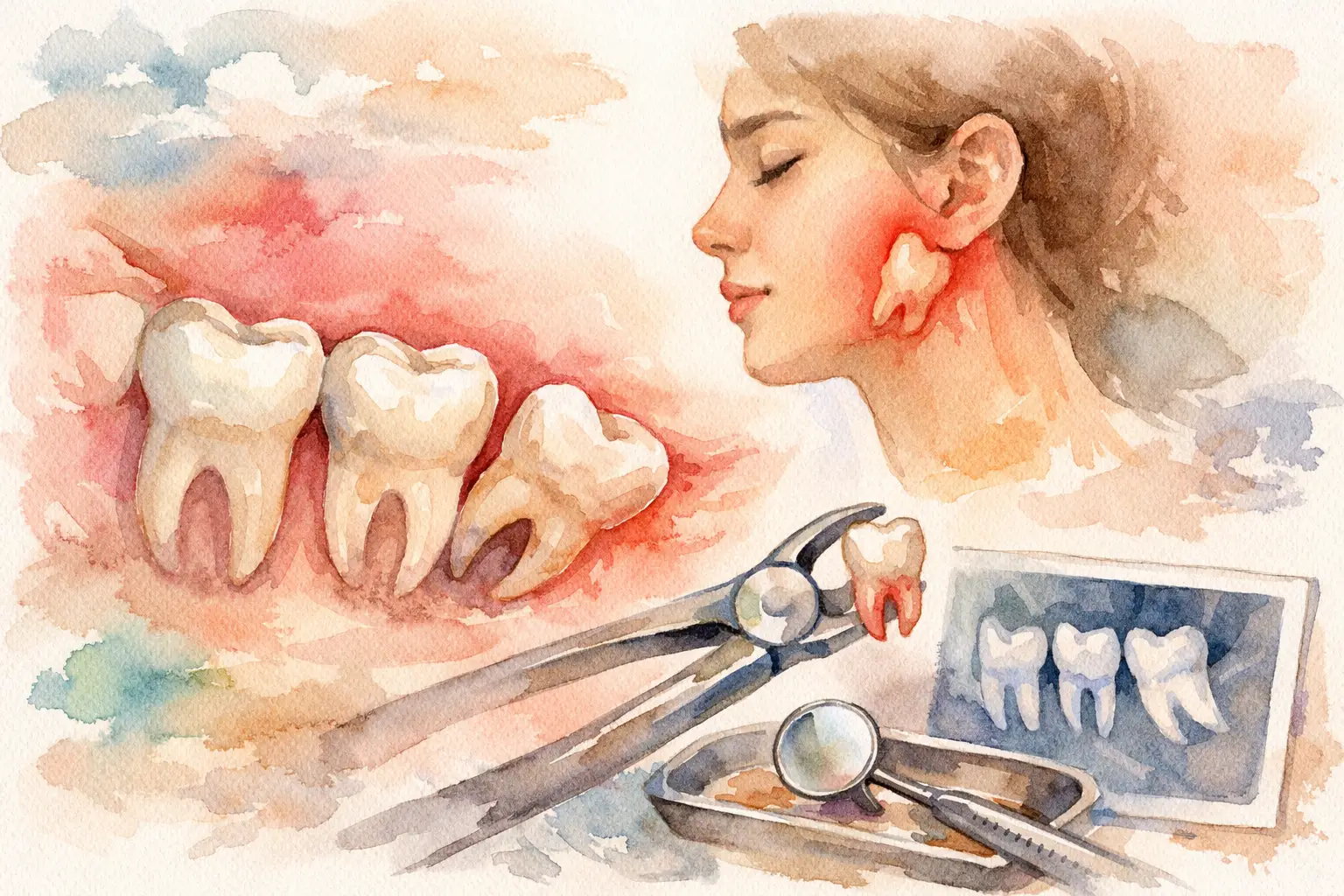
A wisdom tooth can sit quietly for years, then cause pain, swelling, or damage to the tooth in front of it with little warning. So, when should wisdom teeth come out? The answer is not based on age alone. Removal is generally recommended when a wisdom tooth is causing disease, has a high likelihood of causing future problems, or cannot be kept clean and healthy in its position.
For many patients, the right time is identified during a routine dental examination and X-ray, before repeated infections or irreversible damage occur. A specialist assessment considers the tooth’s position, root development, relationship to nerves and sinuses, your symptoms, and the long-term health of the surrounding teeth and jawbone.
When Should Wisdom Teeth Come Out?
Wisdom teeth, also called third molars, usually begin to emerge between the late teens and mid-twenties. Some grow into a functional position and remain healthy for life. Others are partially erupted, trapped beneath gum or bone, or angled toward the neighboring second molar. These teeth are described as impacted.
An impacted wisdom tooth does not automatically need surgery. However, a tooth that is difficult to clean or positioned in a way that threatens adjacent structures deserves close attention. The decision should be individualized rather than based on a rule that every wisdom tooth must be removed.
Removal is often advised when there is evidence of recurrent infection, decay that cannot be reliably treated, gum disease around the tooth, cyst formation, damage to the neighboring molar, or persistent pain linked to the wisdom tooth. In some cases, an otherwise symptom-free impacted tooth may be recommended for removal because imaging shows a clear risk to the tooth in front of it or because monitoring it would be unreliable.
Repeated Gum Infection Around a Partially Erupted Tooth
A lower wisdom tooth that has only partially broken through the gum may develop a flap of tissue over its chewing surface. Food debris and bacteria can collect beneath this flap, causing pericoronitis, an infection of the surrounding gum.
Symptoms can include tenderness behind the last molar, swelling, a bad taste, difficulty opening the mouth, and discomfort when swallowing. A first mild episode may sometimes be managed conservatively. Recurrent episodes, however, are a strong reason to discuss extraction, particularly when the tooth has no realistic path to full, clean eruption.
Decay and Gum Disease That Cannot Be Controlled
Wisdom teeth are at the very back of the mouth, where brushing and flossing are often difficult. A deeply angled or partly erupted tooth can develop cavities that are hard to restore. More importantly, it may create a plaque trap against the second molar, placing a tooth with an important long-term function at risk.
Periodontal disease around a wisdom tooth can also lead to bone loss behind the second molar. Removing the wisdom tooth before that damage becomes advanced may help protect the adjacent tooth. The trade-off is that extraction is still a surgical procedure, so the expected benefit should clearly outweigh the risks for each patient.
Pressure, Damage, Cysts, or Other Changes Seen on X-Ray
Not all concerns are visible in the mirror. A panoramic X-ray can show whether a wisdom tooth is pressing against the roots of the second molar, associated with a cyst-like lesion, or positioned within bone in a way that may affect nearby structures.
Rarely, impacted teeth are associated with more significant pathology. This is why periodic review matters even when there is no pain. A specialist may recommend further three-dimensional imaging, such as cone beam CT, when the roots of a lower wisdom tooth appear close to the inferior alveolar nerve, which supplies sensation to the lower lip and chin.
Symptoms That Need Prompt Assessment
Pain is not the only sign that a wisdom tooth needs attention. Arrange an examination if you have ongoing discomfort at the back of the jaw, swelling of the gum or face, repeated bad taste or drainage, bleeding gums around the last molar, or food consistently becoming trapped in that area.
More urgent assessment is appropriate if facial swelling is increasing, you have fever, difficulty opening your mouth, trouble swallowing, or difficulty breathing. Dental infections can spread beyond the tooth and should not be managed by waiting for them to settle on their own. Antibiotics may be necessary in selected situations, but they do not remove the underlying cause when a wisdom tooth remains a source of recurrent infection.
Is There a Best Age for Wisdom Tooth Removal?
For patients who need removal, the late teens and early twenties can be a practical time because the roots may not yet be fully formed and healing capacity is often favorable. That does not mean wisdom tooth surgery should be performed simply because someone reaches a certain birthday.
Adults can have wisdom teeth removed safely as well. The procedure may be more technically involved when roots are fully developed, bone is denser, or the tooth lies close to a nerve or sinus. Health conditions, medications, smoking status, and the complexity of impaction can also influence recovery and surgical planning.
The most useful principle is timely treatment rather than age-based treatment. If a tooth is already causing harm, delaying assessment can increase the chance of infection, decay, or damage to the adjacent molar. If it is fully buried, disease-free, and unlikely to affect neighboring structures, clinical and radiographic monitoring may be a reasonable option.
How a Specialist Decides Whether Removal Is Right
A thorough consultation begins with your symptoms, dental history, and medical history. The surgeon then examines the gum, bite, jaw opening, and neighboring teeth, and reviews imaging to understand the tooth’s orientation and anatomy.
For upper wisdom teeth, the relationship to the maxillary sinus may affect the surgical approach. For lower wisdom teeth, the key consideration is often proximity to the inferior alveolar nerve. When the risk of nerve disturbance is significant, a specialist may discuss alternatives such as coronectomy. In this procedure, the crown of the tooth is removed while roots closely associated with the nerve are intentionally left in place. It is not suitable for every case, particularly when infection or disease involves the roots, but it can be an appropriate risk-reduction strategy for selected patients.
This level of planning also helps determine whether the procedure can be performed under local anesthesia, with sedation, or in a hospital setting when medical needs or surgical complexity call for it. The aim is not simply to remove a tooth, but to do so with a careful approach that protects comfort, function, and surrounding anatomy.
What Recovery Usually Involves
Most patients experience swelling, jaw stiffness, and discomfort for several days after wisdom tooth removal. These effects commonly peak around the second or third day and then improve. The degree of recovery varies with the number of teeth removed, depth of impaction, surgical complexity, and individual healing.
Following the post-operative instructions closely supports predictable healing. This typically includes controlling bleeding with gauze as directed, taking prescribed medications appropriately, choosing soft foods initially, maintaining careful oral hygiene, and avoiding smoking or vigorous rinsing during the early healing period. Smoking and vaping can significantly increase the risk of delayed healing and dry socket.
Contact your surgical team if pain becomes more severe after initially improving, swelling continues to worsen, you develop fever, experience persistent numbness, or have concerns about bleeding. Early review can distinguish normal healing from a complication that needs treatment.
When Observation May Be Appropriate
Observation can be appropriate for an impacted wisdom tooth that is completely covered by healthy bone or gum, has no evidence of decay, cysts, gum disease, or damage to the adjacent tooth, and can be monitored with regular examinations and X-rays. This is an active management decision, not a reason to forget about the tooth.
The balance can change over time. A wisdom tooth that was harmless at age 20 may become harder to clean or begin affecting the second molar later. Regular dental care creates an opportunity to reassess before symptoms become severe.
If you are unsure whether a wisdom tooth is merely present or truly problematic, a specialist evaluation can provide clarity. A carefully reviewed scan and a personalized discussion can replace uncertainty with a plan that protects your oral health for the years ahead.