If your bite feels off, your jaw looks uneven, or chewing and breathing have become harder than they should be, you may be wondering how to qualify for jaw surgery. That question usually comes up after years of adapting – cutting food smaller, avoiding photos from certain angles, living with jaw strain, or being told braces alone may not solve the problem. Qualification is not about checking a single box. It is a careful clinical decision based on function, facial structure, dental alignment, and long-term stability.
Jaw surgery, also called orthognathic surgery, is recommended when the position of the upper jaw, lower jaw, or both creates problems that cannot be corrected predictably with orthodontics alone. For some patients, the main concern is difficulty biting, chewing, or speaking clearly. For others, the issue includes facial imbalance, sleep-disordered breathing, or chronic strain on the jaw joints and surrounding muscles. In many cases, the functional and aesthetic concerns are connected.
How to qualify for jaw surgery in clinical terms
To qualify for jaw surgery, a specialist needs to confirm that the underlying problem is skeletal, not just dental. Teeth can be moved with braces or aligners. Jaw bones cannot be repositioned meaningfully without surgery once growth is complete. That distinction matters because many patients have crowding or bite irregularities that look severe but can still be treated orthodontically. Others have a jaw discrepancy hidden behind years of dental compensation.
A typical candidate has one or more skeletal issues such as an underbite, overbite, open bite, facial asymmetry, a recessed lower jaw, an excessively prominent jaw, or vertical maxillary excess. These patterns may affect the way the teeth meet, the profile of the face, lip support, chin position, and airway space. The more significant the skeletal mismatch, the more likely surgery becomes part of the treatment plan.
Qualification also depends on whether the problem causes real limitations. A patient who cannot incise food properly, cannot close the lips comfortably, has speech difficulty, or develops strain from forcing the bite into position may be more clearly indicated for surgery than someone with a mild imbalance and no symptoms. The same applies when jaw position contributes to obstructive sleep apnea or when asymmetry is substantial enough to affect both function and facial harmony.
Common signs that surgery may be appropriate
There is no single symptom that proves you need surgery, but certain patterns raise concern. If your front teeth do not touch when you bite, if your lower jaw shifts to one side to find a comfortable position, or if your upper and lower teeth do not align despite previous orthodontic treatment, those are meaningful signs. Chronic mouth breathing, poor chin projection linked to a retrusive jaw, and bite collapse from skeletal discrepancy can also point toward a surgical issue.
Some patients seek consultation because they have been told their jaws are “too small” or “too far forward.” Others come because of long-standing TMJ-related strain, though this requires careful evaluation. Jaw surgery is not a universal solution for every TMJ disorder. In some patients, correcting the jaw relationship helps reduce overload and improve function. In others, joint symptoms may need separate or additional treatment.
Aesthetic concerns are also valid, but they are assessed in context. A specialist does not look only at the teeth or only at the profile. The full analysis includes facial proportions, smile line, jaw projection, symmetry, bite relationship, and soft tissue support. The goal is not to create a generic look. It is to achieve a stable, functional result that also improves facial balance.
Who is a good candidate for orthognathic surgery?
Good candidates are usually older adolescents or adults whose jaw growth is complete or nearly complete. Operating too early can create instability if the bones continue to grow afterward. That is why timing matters, especially in younger patients.
General health also plays a role. You do not need to be perfect medically, but you do need to be well enough for anesthesia, surgery, and recovery. Conditions such as uncontrolled diabetes, active smoking, untreated gum disease, poor oral hygiene, or significant nutritional issues may affect healing and may need to be addressed before treatment proceeds. Commitment matters as much as anatomy. Jaw surgery is a planned process, not a quick cosmetic procedure.
In practical terms, the best candidate is someone with a confirmed skeletal jaw discrepancy, symptoms or limitations related to that discrepancy, and realistic expectations about the treatment journey. You also need to be willing to go through imaging, records, orthodontic coordination when needed, and post-operative recovery.
What specialists assess before confirming you qualify
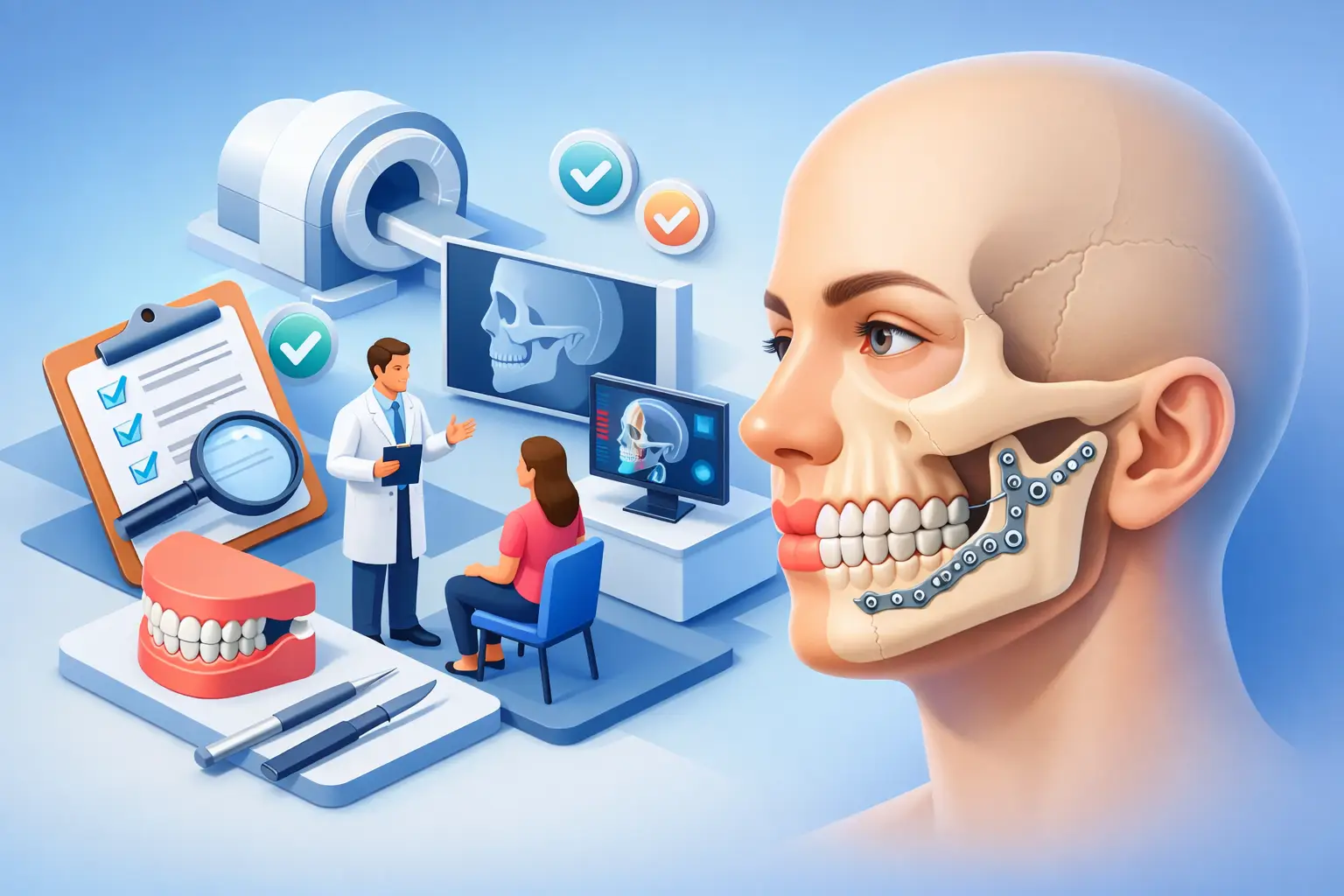
The qualification process begins with a consultation and detailed examination. This includes an assessment of your facial proportions, dental occlusion, jaw movement, and medical history. Photographs, digital scans, and X-rays help the surgeon analyze the relationship between the upper jaw, lower jaw, chin, teeth, and airway.
Cephalometric analysis and 3D imaging are often important because they show what the eye alone cannot fully measure. The surgeon can evaluate jaw position in multiple planes, identify asymmetry, assess tooth inclinations, and plan movements with precision. If breathing is part of the concern, airway assessment becomes especially relevant.
Orthodontic input is often part of the process. Many patients considering surgery have teeth that have compensated for the jaw discrepancy over time. For example, the upper front teeth may tilt one way and the lower front teeth another way to create the best bite possible within an abnormal jaw relationship. Before surgery, orthodontic treatment may be needed to decompensate the teeth so the jaws can be moved into the correct skeletal position. This can make the bite look worse temporarily, but it often makes the final result far better and more stable.
When braces alone are not enough
One of the most common reasons patients ask how to qualify for jaw surgery is that they have already had orthodontic treatment or have been advised that braces alone will camouflage, rather than correct, the real problem. Camouflage can be appropriate in mild to moderate cases, especially if function is acceptable and the patient wants to avoid surgery. But camouflage has limits.
If moving the teeth further would strain the gums, worsen facial balance, or still fail to create a stable bite, surgery may be the more appropriate option. This is especially true for significant open bites, pronounced underbites, severe overjets caused by skeletal discrepancy, and facial asymmetry involving the jaw bases. The choice is not simply about whether braces can move teeth. It is about whether the end result will be functional, healthy, and esthetically balanced.
Reasons you might not qualify right away
Sometimes a patient is a potential surgical candidate but does not qualify immediately. Ongoing growth, untreated dental disease, poor oral hygiene, smoking, or unaddressed medical issues may delay treatment. In other cases, the problem may be too mild to justify surgery when weighed against the recovery and risks.
There are also situations where the symptoms do not match the anatomy. A patient may have facial concerns but no meaningful skeletal discrepancy. Another may have jaw pain driven primarily by muscle tension, joint inflammation, or clenching rather than jaw position. That does not mean the concerns are unimportant. It means the treatment plan needs to fit the actual diagnosis.
This is why careful evaluation matters. The right answer is not always surgery, and a trustworthy specialist should be clear about that.
What to expect if you do qualify for jaw surgery
If you qualify, treatment planning becomes highly individualized. The surgeon will explain which jaw or jaws need repositioning, how the bite will change, what orthodontic preparation may be required, and what recovery is likely to involve. Many patients are relieved at this stage because they finally understand why previous treatment felt incomplete or why the problem kept returning.
You should also expect a discussion about goals. For some patients, the priority is chewing efficiency and bite stability. For others, airway improvement, facial symmetry, or lower face balance may be equally important. In a specialist setting such as Aesthetic Reconstructive Jaw Surgery, the planning process typically considers both function and facial outcome, because those two aspects are rarely separate in corrective jaw surgery.
The most useful next step is not trying to self-diagnose from photos or social media before-and-afters. It is getting a proper assessment from a qualified oral and maxillofacial surgeon who can determine whether your concern is dental, skeletal, functional, esthetic, or a combination of all four. If jaw position is truly the source of the problem, clarity tends to replace uncertainty very quickly.
If you have spent years adjusting to a bite that does not feel natural, that adaptation should not be mistaken for normal. A well-planned consultation can tell you not just whether you qualify, but whether surgery would meaningfully improve the way you live every day.