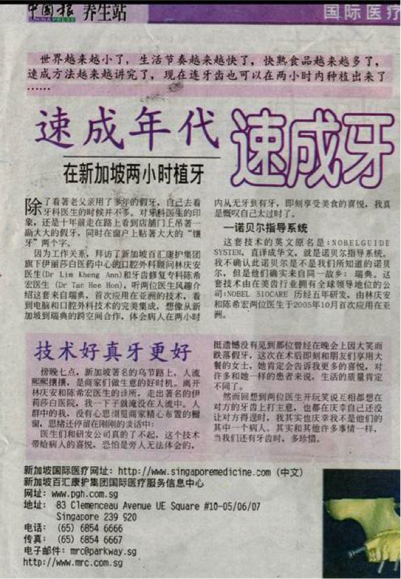
A 60 year old man came into the clinic with a newspaper cutting showing a certain way of doing dental implants and requested for it. The implant company that came up with this technique was marketing direct to the consumers through the mass media. The idea of placing 8 implants on one jaw and attaching a fixed prosthesis onto them immediately was an attractive proposition. To top it off, the whole procedure was to be completed in two hours, with no pain. That was the NobelGuide system. How does is it work?
NobelGuide, like many other systems now available, is a process of reverse engineering the implant placement. Bearing in mind that what patients really wanted are fixed teeth that look good and function like real teeth, implant treatment planning must begin with the end, i.e. the final prosthesis.


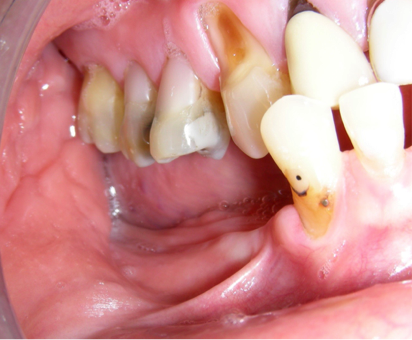
A physical examination and CT scans were done and it showed that he did not have sufficient bone to support implants. As such, prior to any implant placement, the upper jaw needed bone grafting to rebuild the bone mass. Bone was taken from his hip bone and grafted to the upper jaw. Six months later, after the grafted bone had healed and fused with the jaw bone, planning for the new prosthesis started.

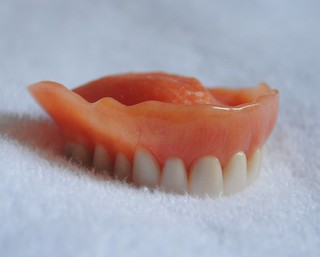
First a new denture was fabricated in accordance to the patient’s preference for size of teeth, shape, amount of lip support, etc. Once this new setup was done, radiopaque markers were embedded into the denture. The patient took a CT scan with the denture in his mouth first and thereafter, we took a CT scan of the denture itself. These CT scan data were entered into the NobelGuide software. Using the models generated on the computer, the implants were placed digitally in the ideal position to support the prosthesis. This plan was then uploaded to the NobelBiocare laboratory in Sweden where a implant placement guide is constructed using computer-aided design and computer-aided manufacturing (CAD-CAM).
 The purpose of the implant placement guide was to ensure that the implants were placed in exactly the same position, angulation and to the same depth as planned on the program. That in turn would ensure that the ideal prosthesis could be constructed on them. With the confidence that the implant positions would be accurately replicated in the patient, we could proceed to make the prosthesis even before the implants were placed.


When the prosthesis was ready, the patient came for the actually surgery. The implant placement guide was placed in the mouth and the implants were inserted in accordance with the planned positions. The NobelGuide came with a set of special instruments to enable accurate placement of implants through the guide.


Once all the implants were placed, the guide was removed and the pre-fabricated prosthesis was attached to the implants.
Although it has been marketed as “teeth-in-an-hour”, it does not mean that everything can be completed in one hour. The actual surgery to place the implants using the implant placement guide takes less than an hour because the positions are all pre-planned and controlled. The attachment of the prefabricated prosthesis also takes a very short time because they were made from the same implant placement guide. However, there is a lot of pre-operative planning that takes many hours.


While it has been marketed as a time-saving protocol, it is in reality more time consuming. The usual preoperative planning is needed. In addition, there is the need to make a new diagnostic or planning prosthesis to determine the ideal position of the teeth for the final prosthesis. Furthermore, time is needed for the planning on the software, getting the company’s laboratory in Sweden to manufacture the guide, sending the guide to a Singapore dental laboratory to pre-fabricate a prosthesis, etc. On the average, from the time the patient came for the first consultation to the final prosthesis being fitted, at least two months is needed. If the patient does not have adequate bone like the above patient, an additional six months is needed for the bone graft to heal.
The main advantage of this method of placing implants lies in the minimally invasive nature and the immediate restoration of a fixed prosthesis that the patient can eat and chew on right after surgery.
Understanding Dental Implants: Cost, Risks & Long-Term Success
Discover the realities of dental implant pricing, safety, and long-term outcomes. These videos guide patients on the full range of dental implants, from affordable to premium options. They cover important factors, including surgical expertise, material selection, bone and gum grafting, and ongoing maintenance.