
Complex Implant Reconstruction in Patients with Complex Needs
Specialist planning for patients who require more than a straightforward dental implant
Dental implant treatment is sometimes simple. A tooth is missing, there is adequate bone, the surrounding tissues are healthy, and an implant can be planned predictably.
Other patients require more careful assessment.
Some have severe bone loss. Some have failed implants. Some have medical conditions that affect healing. Some have infection, previous surgery, sinus involvement, nerve proximity, gum or bone defects, or a history of complex dental treatment. In these situations, implant treatment is not just about placing an implant. It is about diagnosis, risk assessment, reconstruction, sequencing and long-term planning.
At our clinic, complex implant cases are assessed from an oral and maxillofacial surgical perspective, with careful attention to the patient’s dental condition, jawbone anatomy, medical history, bite, soft tissues and long-term restorative needs.
When is an implant case complex?
An implant case may be considered complex when there are anatomical, medical, surgical or restorative factors that make treatment less straightforward.
This may include:
- insufficient bone for implant placement;
- severe gum or bone loss;
- failed or failing dental implants;
- infection around teeth or implants;
- previous bone grafting or implant complications;
- proximity to the maxillary sinus;
- proximity to the inferior dental nerve;
- missing multiple teeth;
- full-arch reconstruction;
- poorly fitting dentures with advanced bone loss;
- previous jaw surgery, trauma or pathology;
- medically complex patients;
- patients taking medications that may affect healing;
- patients requiring coordinated endodontic, periodontal, surgical or restorative planning.
In these cases, the first step is not to ask, “Can an implant be placed?” The more important question is:
What is the safest, most predictable and most appropriate reconstruction for this patient?
Patients with Complex Needs
Some patients require additional planning because their overall condition affects treatment choice.
This may include patients with:
- diabetes or other conditions that affect healing;
- a history of cancer treatment or radiotherapy;
- osteoporosis or medications affecting bone metabolism;
- bleeding risks or anticoagulant medication;
- immune-related conditions;
- significant dental anxiety;
- advanced age with multiple dental problems;
- long-standing denture use and jawbone shrinkage;
- previous failed dental treatment;
- complex bite or jaw relationships;
- difficulty chewing because of multiple missing teeth.
The presence of a medical condition does not automatically mean implant treatment is impossible. However, it may change the timing, planning, technique, risk discussion and maintenance requirements.
Complex implant reconstruction may involve several stages. Depending on the case, treatment may include:
- removal of hopeless teeth;
- assessment of whether a tooth can be saved;
- management of infection;
- bone grafting;
- sinus lift or sinus floor augmentation;
- ridge preservation after extraction;
- implant removal and site reconstruction;
- soft tissue grafting;
- staged implant placement;
- guided implant planning;
- full-arch implant reconstruction;
- coordination with restorative dentists, endodontists, periodontists or orthodontists.
Some patients may be suitable for immediate implant placement. Others may require staged treatment to allow infection to resolve, bone to heal or grafted areas to mature.
The treatment plan is individualised according to the patient’s anatomy, health, expectations and long-term prognosis.
Failed implants and implant complications
A failed or failing implant can be distressing. Patients may notice looseness, pain, swelling, gum recession, pus, bleeding, bone loss or difficulty chewing. Sometimes the problem is discovered only on an X-ray or CBCT scan.
Assessment of a failed implant may include:
- whether the implant itself has failed;
- whether the surrounding bone has been lost;
- whether infection is present;
- whether the implant position is restorable;
- whether the bite or prosthesis contributed to the problem;
- whether removal is required;
- whether bone grafting is possible;
- whether a new implant can be placed later;
- whether another treatment option may be more suitable.
Not every implant problem requires immediate removal. Not every failed implant site can be reconstructed in the same way. A careful diagnosis is important before deciding on treatment.
Bone loss and bone grafting
Dental implants require adequate bone for stability, support and long-term function. Bone may be lost after tooth extraction, infection, gum disease, trauma, cysts, previous failed implants or long-term denture use.
When there is insufficient bone, bone grafting may be considered to rebuild the implant site.
Bone grafting may be used to:
- preserve the socket after extraction;
- rebuild a narrow ridge;
- increase bone height or width;
- repair defects after infection;
- reconstruct a failed implant site;
- prepare for future implant placement;
- support more stable and aesthetic implant restoration.
In some cases, grafting and implant placement can be done together. In other cases, staged grafting is safer and more predictable.
Sinus lift and posterior upper jaw implants
The upper back jaw can be especially challenging because the maxillary sinus may enlarge after tooth loss, while the available bone becomes thinner.
In such cases, implant placement may require sinus floor elevation or sinus lift surgery. This allows bone to be developed in the area so that implants can be placed with better support.
Sinus-related implant planning requires careful assessment of:
- available bone height;
- sinus anatomy;
- sinus health;
- previous infection;
- implant length and position;
- grafting requirements;
- timing of implant placement.
CBCT imaging is often useful in assessing these cases.
The role of CBCT and digital planning
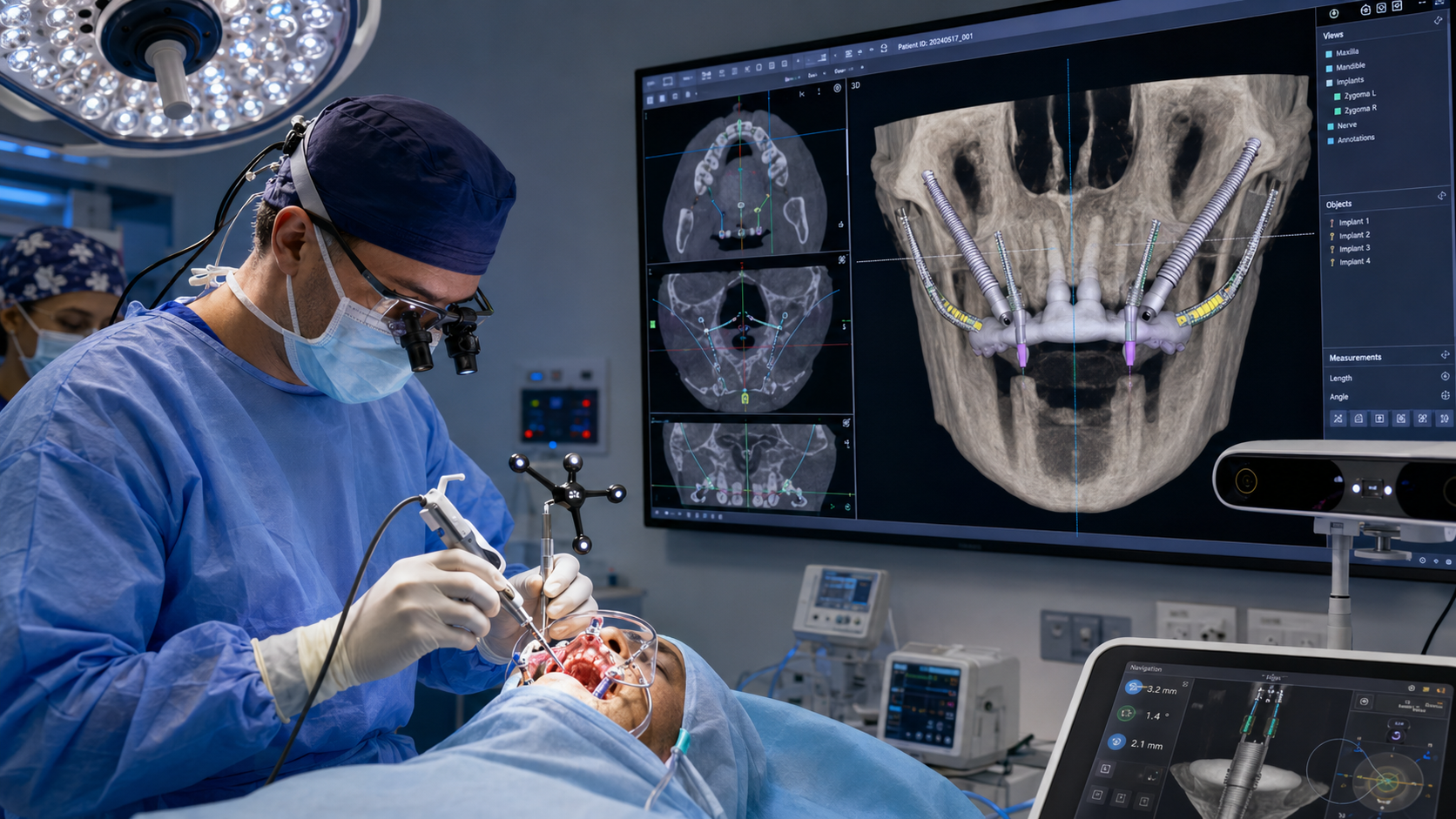
Complex implant treatment often requires three-dimensional assessment. Cone beam CT, or CBCT, allows the jawbone, tooth roots, nerves, sinus and implant site to be assessed more clearly than with a two-dimensional X-ray alone.
CBCT may help with:
- assessing bone volume;
- identifying nerve position;
- assessing sinus anatomy;
- evaluating infection or cysts;
- planning bone grafting;
- assessing failed implants;
- planning implant position;
- evaluating complex root or tooth anatomy;
- improving communication with patients and referring dentists.
Digital planning does not replace clinical judgment. It supports diagnosis, risk assessment and treatment planning.
Tooth Preservation or Implant Replacement
Tooth Preservation or Implant Replacement
Not every compromised tooth should be removed. Some teeth can be predictably preserved with root canal treatment, retreatment, surgical endodontics or restorative care.
At the same time, not every tooth can or should be saved. A tooth with severe structural damage, vertical root fracture, advanced periodontal loss or poor long-term prognosis may be better replaced.
Where appropriate, we assess complex cases from both tooth-preservation and implant-reconstruction perspectives.
This is especially useful when patients have been told:
- “This tooth needs to be extracted.”
- “The root canal has failed.”
- “You need an implant.”
- “There is not enough bone.”
- “The tooth may be cracked.”
- “The infection has returned.”
- “The implant has failed.”
The aim is to help patients understand the realistic options before committing to extraction, retreatment, grafting or implant reconstruction.
Our approach
Our approach to complex implant reconstruction is based on careful diagnosis, staged planning and realistic discussion.
The process may include:
1. Consultation and history
We review the patient’s dental concerns, previous treatment, medical history, medications, expectations and priorities.
2. Clinical examination
The teeth, gums, bite, jaw relationship, soft tissues and existing restorations are assessed.
3. Imaging and diagnosis
Existing X-rays are reviewed. CBCT imaging may be recommended where the case is anatomically or surgically complex.
4. Treatment options
Where appropriate, we discuss tooth preservation, extraction, grafting, implant replacement, staged reconstruction or alternative prosthetic options.
5. Risk and prognosis discussion
Complex cases require an honest discussion of risks, limitations, healing time, maintenance and expected prognosis.
6. Staged treatment planning
Some cases can be treated in one stage. Others require infection control, extraction, bone grafting, healing, implant placement and final restoration over several stages.
7. Long-term maintenance
Complex implant reconstruction does not end when the implant crown is fitted. Maintenance, hygiene, bite control and review are important for long-term stability.
Working with referring dentists
We welcome referrals for complex implant assessment, failed implants, bone grafting, surgical planning and patients with complex needs.
For referring dentists, our aim is to support your treatment plan and help manage the surgical or reconstructive aspects of the case. Where patients are referred for surgical assessment or implant reconstruction, they can be returned to the referring dentist for continuing restorative care unless otherwise requested.
Referral situations may include:
- implant site assessment;
- failed implant opinion;
- bone grafting;
- sinus lift assessment;
- extraction and ridge preservation;
- complex wisdom tooth or surgical extraction before implant planning;
- medically complex implant patients;
- second opinion before extraction or implant treatment;
- surgical support for restorative implant cases.
Is complex implant reconstruction suitable for every patient?
No. Suitability depends on the patient’s oral condition, bone anatomy, medical history, expectations and ability to maintain treatment. Some patients may be better suited to other forms of tooth replacement.
Does severe bone loss mean implants are impossible?
Not always. Some patients with bone loss may be suitable for bone grafting or other reconstructive options. However, the feasibility and predictability depend on the individual case.
Can a failed implant be replaced?
Sometimes. A failed implant site must first be assessed to determine the amount of remaining bone, presence of infection, soft tissue condition, implant position and cause of failure. Bone grafting or staged reconstruction may be required.
Do I always need a bone graft?
No. Bone grafting is only recommended when it is needed to improve the implant site or support the planned reconstruction.
Is CBCT always required?
Not always. CBCT is commonly useful in complex implant cases, especially when bone volume, sinus anatomy, nerve proximity, infection or previous implant failure needs to be assessed.
Can medical conditions prevent implant treatment?
Some medical conditions increase risk or require additional precautions. They do not always prevent implant treatment, but they must be considered carefully before planning surgery.
What if I am not sure whether to save the tooth or remove it?
A tooth-preservation versus implant-replacement assessment can help clarify whether the tooth has a reasonable long-term prognosis or whether replacement may be more appropriate.
Arrange a consultation
If you have been told that your implant case is difficult, have insufficient bone, have a failed implant, or have medical or anatomical factors that make treatment more complex, a specialist assessment can help clarify your options.
Book a consultation to discuss complex implant reconstruction and whether implant treatment, bone grafting, tooth preservation or another approach is most appropriate for your situation.
Complimentary eBooks


Make an Enquiry
Got a Question? Fill up the form and we will get back to you shortly.
Office Tour


Mount Elizabeth Medical Centre
Mount Elizabeth Medical Centre
3 Mount Elizabeth, Suite 04-05
Singapore 228510