

Share this
on April 23, 2026
Disclaimer — The opinions expressed here are purely personal and do not represent any organisation or committee.
The second case
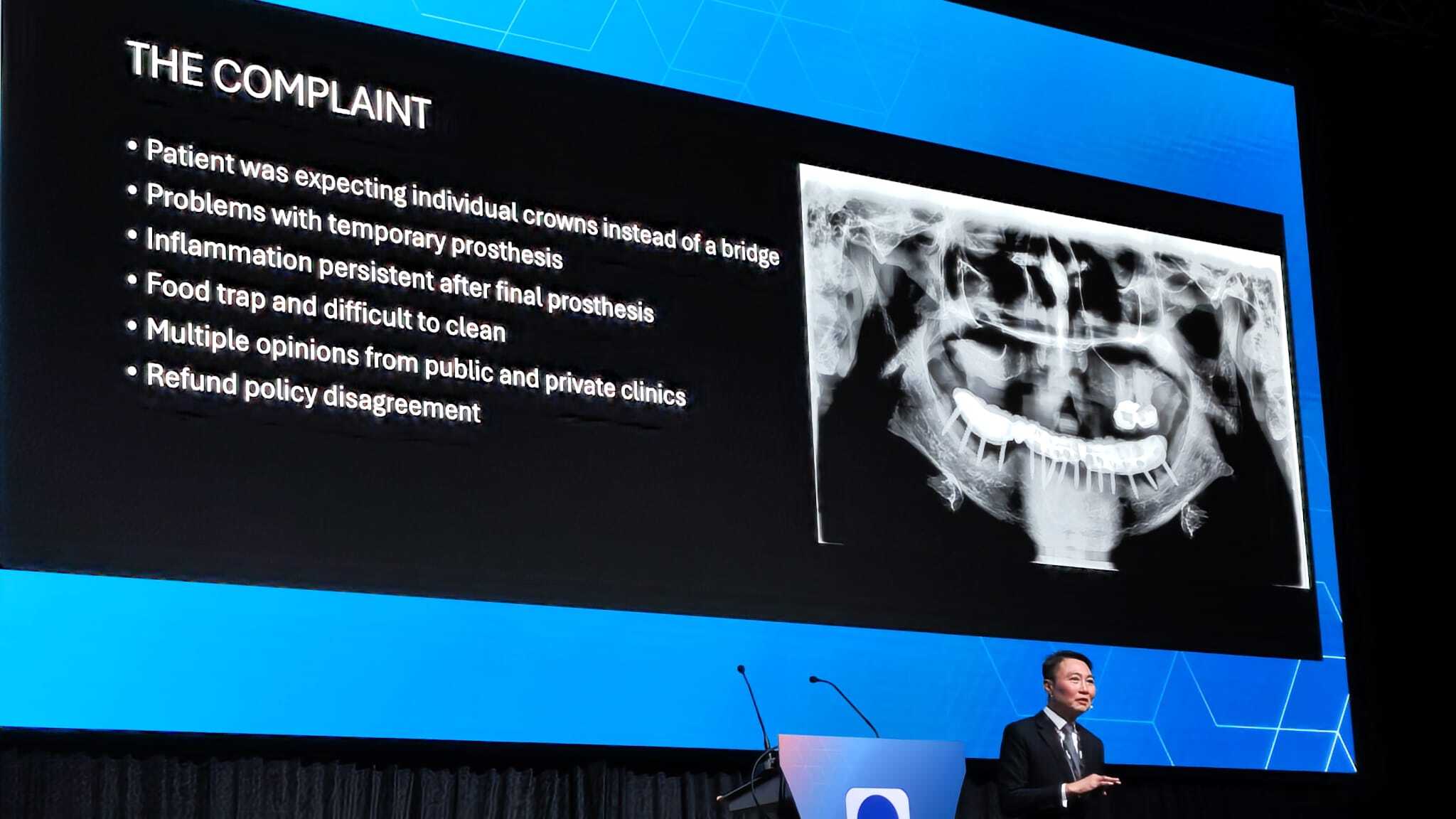
This case involved a senior dentist who was charged with carrying out grossly inappropriate treatment by replacing all the lower teeth of a patient with a 15 mini-implant-supported full-arch prosthesis. I will not describe the details of the case, as they are available online. Unlike the first case, which caused some disquiet when the decision was published, the profession’s reaction to this case was one of acceptance, reflecting the general view that the sentence was appropriate. However, I would like to highlight several aspects of this case that set new precedents which largely went unnoticed by the profession.
The first charge was one of “intentional and deliberate departure from the standard of care.” For this charge to stand, the prosecution needed to establish what the standard of care was. Among other criteria, the use of cone-beam computed tomography (CBCT) was stated to be the standard of care for the insertion of multiple implants for a full-arch prosthesis. Although many clinics have installed CBCT machines over the past twenty years, the technology is still not universally available, and no evidence-based guidelines have been published mandating it as the standard of care.
In addition, the standard of care adopted by the DC prescribed the use of bone grafting to increase bone width before implant placement. The DC further prescribed that “conventional” implants should be used instead of “mini” implants, and that open-flap surgery should be used instead of flapless surgery.
For the second charge, the dentist was accused of serious negligence for substandard technique in cementing the prosthesis, as well as for designing an inappropriate prosthesis that rendered oral hygiene difficult, leading to chronic inflammation.
Establishing a single standard of care has always been challenging, because there are often several ways to solve a clinical problem. Take the CBCT criterion, for example. Before the availability of CBCT, dentists had already been carrying out full-arch and even full-mouth implant treatment successfully. CBCT provides a three-dimensional view that is not available with the routine dental panoramic tomogram, and it is undoubtedly a major improvement. Does a DC stipulating it as the standard of care affect the practice of implant dentistry in Singapore? While it may not become a strict rule, it will certainly cause dentists to think twice before proceeding without a CBCT. What, then, of older, more laborious, albeit less accurate, methods of assessing bone dimensions, such as bone sounding?
In most cases of professional misconduct, the charges focus on pre- and post-operative management rather than the actual treatment itself. This is because it is usually difficult to prove that the execution of the treatment was negligent, as there is rarely another dentist present during the procedure to critique it. As such, most charges tend to focus on lack of informed consent, which is an administrative process and can be assessed objectively based on the documentation. Documentation of pre-operative planning is another area that can be assessed more objectively against an established standard of care. Likewise, postoperative management of complications can be judged more objectively. Charges relating to the actual treatment can generally be framed as either doing the wrong thing, or doing the right thing poorly.
In this case, the charge focused on the inappropriate treatment plan and the poor quality of the prosthesis — in other words, doing the wrong thing poorly. It demonstrated the confidence the prosecution had in the evidence it had gathered, and the dentist’s eventual plea of guilt before the hearing concluded proved that confidence well placed.
Evidence-based guidelines
Nevertheless, this case highlights the need for evidence-based clinical practice guidelines for complex cases. The Academy of Oral and Maxillofacial Implantologists (AOMI), a newly formed international sister organisation of the International Team for Implantology (ITI) that focuses on complex implant patients, was launched in Singapore last year, and the Singapore Chapter was inaugurated in February 2026. AOMI, whose mission is to focus on both the complex patient and complex indications, would be well placed to undertake such a project.
Rehabilitative vs retributive
Another unique aspect of this case was the use of corrective education and training in sentencing. A three-month discount was applied when the dentist agreed to undergo the dental implant course organised by NUS. In a conversation with Dr James Foster from Dental Protection Ltd, it was noted that Asian countries tend to adopt a more retributive or punitive approach to infractions, whereas Western jurisdictions tend to favour a more rehabilitative approach. The DC’s provision of re-education or training as a means of reducing the sentence was a progressive step in the right direction. The disciplinary process will achieve a greater good for Singapore not merely by punishing dentists for infractions, but by encouraging education and improvement of skills, so that after the period of suspension, the dentist is better equipped to serve patients.
Other forms of rehabilitative orders may include requiring the dentist to perform the relevant procedures under supervision a certain number of times before resuming that service, even after the suspension period. I hope this landmark sentence sets a precedent for future DCs in mandating remedial training for dentists who have been found guilty of professional misconduct in clinical treatment.
Sentencing matrix
This case also marked the adoption of the sentencing matrix first introduced by the Singapore Medical Council. Its purpose is to minimise gross discrepancies in sentencing between one case and another. Acknowledging that comparing different cases is like comparing apples and oranges, this matrix seeks to harmonise sentencing by assessing both the harm caused to the patient and the degree of culpability of the dentist.
By determining where a case falls on the matrix — for example, moderate harm and low culpability — similar past cases classified in the same category can be used as a reference point for determining the starting sentence, whether in terms of months of suspension, amount of fine, or other punishment. Aggravating and mitigating factors are then considered, and the appropriate additions or reductions are applied to the starting point to arrive at the final sentence. While there is still an element of subjectivity, it is a more transparent and consistent system.
Aggravating and mitigating factors
Counterintuitively, seniority and standing in the profession are aggravating factors. This is counterintuitive because a dentist who has contributed significantly, and who therefore enjoys a high level of respect from both the profession and the public, will be judged more harshly than someone less well known. The rationale is that an infraction committed by a prominent person brings greater disrepute to the profession, and that the privileges accompanying high social standing make any violation more egregious.
Not pleading guilty is not an aggravating factor, although pleading guilty is generally considered a mitigating factor. It is not treated as aggravating because it is the respondent’s right to claim trial. Pleading guilty implies remorse and contrition, and perhaps also openness to rehabilitation, while at the same time saving the system the time and resources that would otherwise be spent on the hearing.
An inordinate delay by the prosecution is considered a mitigating factor, and precedent has been set in the High Court for a reduction in sentence on that basis. The rationale is that undue delay in the prosecution process causes undue stress to the respondent. However, to justify a reduction in sentence, the delay must have been caused by the prosecution rather than by the respondent.
What causes delays?
The delay may arise from the SDC secretariat or the law firm appointed to conduct the prosecution. It may also be caused by the unavailability of DC members on the preferred dates. Scheduling is often challenging, as it requires many people to be available for a continuous period of one to two weeks for the hearing. All parties do take considerable pains to expedite the process, but some delays are inadvertent, and the courts are cognisant of the stress such delays place on the respondent. In some cases, they have ordered sentence reductions by way of compensation.
How was the sentence derived in this case?
The DC determined that the case fell within the category of severe harm and medium culpability. Based on precedent, similar infractions had attracted a suspension of 30 months. Due to the delay of more than three years in prosecution, and again based on precedent, a 40% reduction was applied, bringing the suspension down to 18 months. A further reduction of three months was granted because the respondent agreed to undergo the dental implant course at NUS, resulting in a final sentence of 15 months’ suspension. In addition, a fine of $15,000 was imposed.
I will discuss the third case in the next post.
Share this
Subscribe by email
Email subscription

 +65 97299061
No Comments Yet
Let us know what you think